
Aesop’s The Wolf and the Lamb: Themes, Morals, and Allegories


The Logic of the Lawless
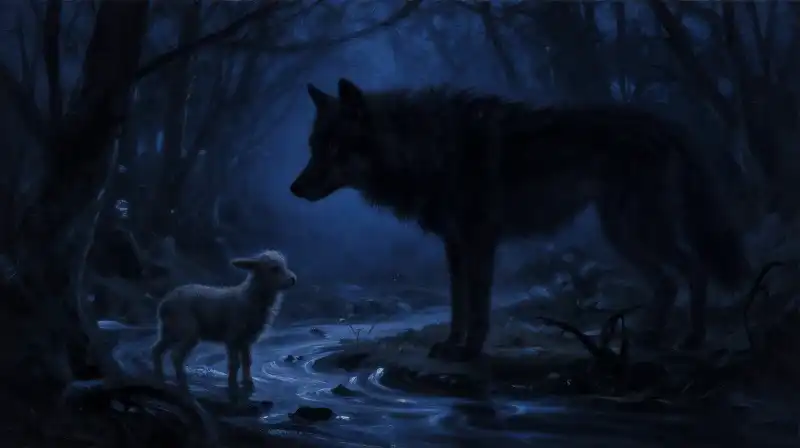
A lamb stands downstream, drinking quietly from a clear woodland stream. A wolf, positioned upstream, watches the water cloud with silt and decides that the lamb is the culprit. When the lamb offers a perfectly logical defense—that the water flows from the wolf toward the lamb, making it physically impossible for the lamb to be muddling the wolf’s supply—the wolf does not retreat. Instead, he pivots. He accuses the lamb of insults made a year prior, or of slanderous words spoken by the lamb’s father [1, 2]. The lamb’s reasoning is sound, but it is irrelevant; the wolf has already decided on the outcome: the lamb must be eaten [2, 3].
This is Aesop’s “The Wolf and the Lamb” (numbered 155 in the Perry Index), perhaps the most enduring study of systemic injustice ever penned [3]. While many view fables as simple moral lessons for children, this specific narrative functions as a chilling dissection of how power operates when it is decoupled from truth. It is not a story about a misunderstanding; it is a story about the deliberate use of false accusations to justify pre-existing intent [3].
What is the moral of The Wolf and the Lamb?
The most common question regarding this fable is its moral purpose. Unlike stories where a character learns a lesson through error, “The Wolf and the Lamb” offers a grim observation of a world where the victim cannot “win” through virtue or logic. The primary moral is that a tyrant will always find an excuse for his tyranny [1, 3].
More specifically, the fable teaches that:
- Reason is powerless against malice: The unjust will not listen to the reasoning of the innocent [1, 3].
- Might often masquerades as right: In many interpretations, the story serves as a warning that those in power can manipulate “truth” to suit their appetites [3].
- Pretext is the tool of the predator: The wolf does not need a real crime; he only needs a perceived one to validate his violence [1, 2].
Thematic Dimensions: Beyond the Forest

To understand why this fable persists, one must look past the animals and toward the structures they represent. The “Wolf” and the “Lamb” are not merely characters; they are archetypes of social and political roles.
The Breakdown of Rationality
The tension in the story arises from the collision of two different systems: the lamb’s system of logos (logic and evidence) and the wolf’s system of will (desire and dominance). The lamb attempts to use the physical reality of the stream—the direction of the current—to defend himself [2]. However, the wolf bypasses the physical reality to engage in psychological or historical fabrication [1, 2]. By accusing the lamb of past grievances or familial insults, the wolf moves the goalposts from “did you do this?” to “do I have a reason to dislike you?” This transition is the hallmark of arbitrary power [3].
The Fable as Political Mirror
Because the fable is so precise in its depiction of injustice, it has been used for centuries as a tool for political dissent. When a regime uses false pretenses to seize property or silence citizens, the “Wolf and the Lamb” becomes a shorthand for that reality.
Historical applications of the text include:
- The Bayeux Tapestry: Some scholars suggest the 11th-century tapestry may have utilized the imagery of the fable to express dissent against the Norman Conquest of 1066 [3].
- 19th-Century Satire: In a famous cartoon in Punch magazine, the fable was repurposed as “The French Wolf and the Siamese Lamb” to mock French imperialist ambitions in the Kingdom of Siam [3].
- Social Critique: The 15th-century poet Robert Henryson used the characters to critique specific social classes, targeting dishonest lawyers and exploitative aristocrats [3].
Comparative Perspectives in Fable and Folklore
Aesop’s work does not exist in a vacuum. The “unjust accusation” is a recurring structural motif in global folklore, though the nuances of the “predator” change depending on the culture.
| Work / Tradition | Core Dynamic | Key Nuance |
|---|---|---|
| Aesop’s “The Wolf and the Lamb” | Wolf vs. Lamb | Focuses on the futility of logic against a tyrant [3]. |
| Greek “The Cock and the Cat” | Predator vs. Prey | Shares the structural theme of an unjust accusation [3]. |
| Buddhist “Dipi Jataka” | Panther vs. Goat | An Eastern variation of the predator-prey injustice [3]. |
| Ivan Krylov’s Interpretations | Ironic Social Critique | Emphasizes the sentiment: “My need of food is guilt enough of yours” [3]. |
From Oral Tradition to High Art

The transition of “The Wolf and the Lamb” from an oral teaching tool to a subject of high culture demonstrates its profound psychological resonance. It has moved through various mediums, proving that its themes are not tied to the simplicity of a children’s story.
The fable has been elevated through:
- Literature: Jean de la Fontaine’s French adaptations led to the enduring proverb La raison du plus fort est toujours la meilleure (“The strongest side always carries the argument”) [3].
- Visual Arts: The story was immortalized in the oil paintings of Jean-Baptiste Oudry at the Palace of Versailles [3].
- Music: Various French composers have used the narrative as a subject for musical compositions, treating the tension between the characters as a dramatic arc [3].
Why It Matters
Aesop’s “The Wolf and the Lamb” remains essential because it refuses to offer a happy ending. In many fables, the cleverness of the protagonist provides a way out; here, cleverness is a liability. The lamb is “correct,” but being correct does not save him. By stripping away the hope of a logical resolution, the fable forces the reader to confront a hard truth: justice and truth are not self-executing. They require a framework of power that respects them. When that framework is absent, the “wolf” does not need to be right—he only needs to be strong.
Sources

- Library of Congress Aesop Fables — read.gov
- The Wolf and The Lamb — fablesofaesop.com
- The Wolf and the Lamb — en.wikipedia.org
Frequently Asked Questions
What is the moral of The Wolf and the Lamb Aesop?
The primary moral is that a tyrant will always find an excuse for his tyranny. It further teaches that reason is powerless against malice, might often masquerades as right, and that predators use pretext to validate their violence.
Related Articles