
Top Sci-Fi Book Series: From The Expanse to The Culture Guide

Introduction
To enter a long-running science fiction series is to sign a contract with a secondary reality. Unlike the standalone novel, which offers a closed loop of tension and resolution, a sprawling space opera or a multi-generational saga demands an investment in world-building that transcends mere plot. The reader is not just following a protagonist; they are learning the physics of a new solar system, the sociopolitical frictions of interplanetary trade, and the evolving ethics of post-humanity. The challenge for the reader is often knowing where to begin: do you start with the foundational classics that established the genre’s grammar, or do you dive into the modern, high-octane narratives that redefine its boundaries?
The “best” science fiction series is rarely a matter of consensus, because the genre functions as a broad umbrella. One reader may seek the rigorous, mathematically grounded “hard” science of a Martian terraforming project, while another seeks the philosophical weight of a civilization managed by sentient AI. By categorizing these works through their stylistic and thematic approaches, we can navigate the vastness of the genre and find the specific cosmic scale that resonates with our own inquiries.
The Pillars of Space Opera and World-Building
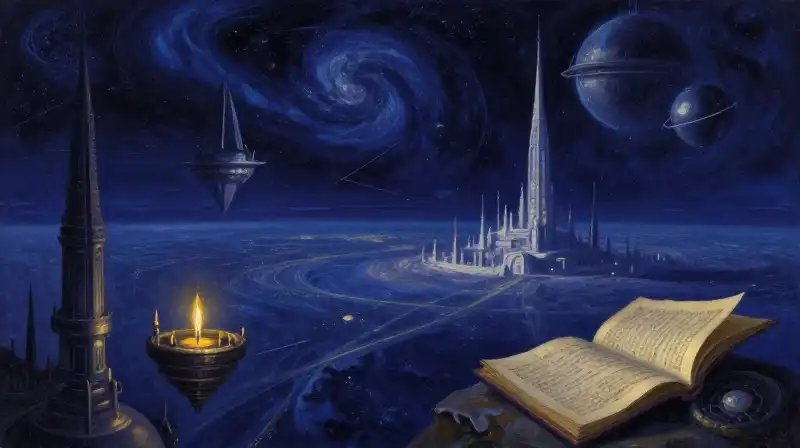
Space opera is often characterized by its scale—vast distances, interstellar empires, and epic conflicts. However, the most enduring series in this subgenre do more than move ships through vacuum; they build coherent, lived-in universes.
- Iain M. Banks, The Culture series: Frequently cited as a premier example of massive, world-building-heavy space opera [1], Banks’ work explores a post-scarcity utopia managed by benevolent, hyper-intelligent Minds. It moves beyond simple adventure to ask deep questions about autonomy, hedonism, and the morality of intervention in less advanced civilizations.
- Dan Simmons, The Hyperion Cantos: An iconic work that stands apart from more traditional military-focused sci-fi [1]. Using a structure reminiscent of Chaucer’s Canterbury Tales, Simmons weaves together various character perspectives to explore themes of religion, time, and the nature of divinity through a cosmic lens.
- Alastair Reynolds, Revelation Space series: For readers drawn to the expansive scope and technological density found in media like the Mass Effect series, Reynolds offers a darker, more “gothic” take on space exploration [1]. His work often grapples with the terrifying implications of deep time and the remnants of extinct civilizations.
Political Realism and Hard Science Fiction
While some series look toward the transcendent, others look toward the sociological. These works use science as a grounding force to explore how humanity might fracture or coalesce under the pressure of new environments.
| Series / Author | Primary Focus | Key Characteristics |
|---|---|---|
| The Expanse (James S.A. Corey) | Political Thriller | Focuses on the tensions between Earth, Mars, and the Asteroid Belt; often compared to “Game of Thrones in space” [1]. |
| Mars Trilogy (Kim Stanley Robinson) | Hard Science / Sociology | An established cornerstone for readers interested in scientifically grounded speculative fiction and the complexities of terraforming [1]. |
| Foundation (Isaac Asimov) | Sociological Science | A foundational work centered on psychohistory—the ability to predict the future of large populations through mathematical models [1]. |
The Military and Dystopian Edge
For those who prefer their science fiction with a sense of urgency and conflict, the military subgenre provides a framework for examining leadership, the dehumanization of warfare, and the struggle against stratified societies.
The Human Cost of Conflict: Works like Joe Haldeman’s The Forever War and John Scalzi’s Old Man’s War series are significant entries for readers interested in the specific mechanics and psychological tolls of military service in space [1]. These narratives often move beyond the spectacle of battle to examine how time dilation and alien environments reshape the soldier’s identity.
Dystopian Evolution: Pierce Brown’s Red Rising series offers a high-octane blend of dystopian sci-fi and war narrative [1]. It follows a miner-turned-revolutionary within a genetically stratified society, using the space opera setting to critique rigid class structures. Similarly, Orson Scott Card’s Ender’s Game series is noted for its evolution, transitioning from traditional space opera into deeper, more complex themes in its later installments [1].
Tactical Realism: Readers seeking realistic battle sequences may turn to Jack Campbell’s Lost Fleet series, written by a former US Navy officer [1]. While it excels in tactical precision, some readers note it may prioritize maneuvers over the deep character development found in more literary works [1].
Navigating the Reader’s Journey
What is considered the best sci-fi series?
The answer depends on your definition of “best.” If you value philosophical depth and scale, The Culture is often the benchmark. If you seek political tension and realistic physics, The Expanse is the modern standard. For those looking for the historical roots of the genre, Asimov and Clarke are indispensable [1].
Where should a beginner start?
For a contemporary and accessible entry point, consider the following paths:
- The “Hard Science” Path: Start with Andy Weir’s Project Hail Mary or the Bobiverse series. These are noted for being highly accessible while maintaining scientific curiosity [1].
- The “Classic” Path: Begin with the standalone works of Arthur C. Clarke, such as Childhood’s End or 2001: A Space Odyssey, which serve as essential pillars of the canon [1].
- The “Imaginative Futurism” Path: Explore the works of Charlie Stross (such as Accelerando), which represent a high-water mark for readers interested in the rapid, often strange acceleration of technological progress [1].
Synthesis: The Infinite Horizon
The enduring power of science fiction series lies in their ability to act as a mirror. By projecting human behavior onto the canvas of the stars, these authors allow us to examine our politics, our religions, and our very definitions of “human” from a safe, yet profound, distance. Whether it is the meticulously calculated terraforming of Kim Stanley Robinson or the grand, sweeping sociology of Isaac Asimov, these works matter because they do not merely predict the future—they interrogate the possibilities of our survival within it. To read a great series is to inhabit a world that feels entirely alien, yet fundamentally recognizable.
Sources
- Great sci-fi books/book series? : r/scifi — reddit.com
- NPR: Top 100 Science Fiction and Fantasy Books — sffbookreview.wordpress.com
Frequently Asked Questions
What is considered the best sci-fi series?
There is no single consensus on the best series because the answer depends on individual reader values. For example, The Culture is a benchmark for philosophical depth and scale, while The Expanse is the modern standard for political tension and realistic physics.
Related Articles