Aesops Fables: The Legacy and Origins of the Classic Treasury

Introduction
A tortoise, moving with agonizing slowness, outpaces a hare that has succumbed to its own arrogance. A lion spares a mouse, only to find that the tiny creature later rescues him from a hunter’s net. These are not merely children’s stories; they are the foundational blueprints of Western moral instruction. The tales attributed to Aesop represent a unique intersection of oral tradition and literary archetypes, distilled into short, punchy narratives designed to reveal the hidden mechanics of human behavior. While the specific authorship of these fables is a subject of historical debate, the collection known as The Classic Treasury of Aesop’s Fables serves as a vital repository for these enduring lessons, preserved through centuries of oral retelling and written transcription [1].
The Mystery of Aesop
To understand the fables, one must first grapple with the shadow of the man himself. Historical tradition presents Aesop not as a polished man of letters, but as a figure of resilience and wit. According to many classical accounts, Aesop was a slave in ancient Greece, a status that complicates our understanding of his “authorship.” This biographical detail is often linked to the question of his physical condition; historical inquiries frequently ask about Aesop’s disability, with many traditions suggesting he was physically impaired or lame [[1]].
This perceived marginalization is central to the literary power of the fables. By using animals as proxies, Aesop—or the tradition that bears his name—was able to critique power structures, social hierarchies, and human folly without the immediate danger of direct political confrontation. The fable, therefore, is a tool of the disenfranchised: a way to speak truth to power through the veil of metaphor.
The Craft of the Fable
The fable is a highly disciplined genre. Unlike the fairy tale, which often relies on magic and sprawling world-building to explore themes of good versus evil, the fable is grounded in a sharp, almost clinical observation of character. It functions through a specific set of literary mechanics:
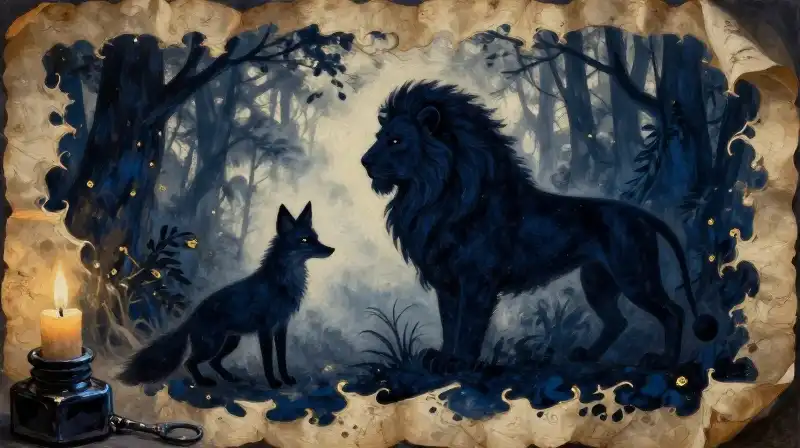
- Anthropomorphism as Psychological Mirror: Animals are not chosen at random. The fox represents cunning, the lion represents strength or sovereignty, and the ant represents industriousness. By stripping away human complexity and assigning these singular traits to animals, the writer can isolate a specific moral problem.
- The Brevity of Action: There is no wasted movement in an Aesopic fable. The narrative moves rapidly from the encounter to the conflict, and finally to the consequence. This economy of language ensures that the reader’s focus remains entirely on the causal link between an action and its outcome.
- The Epimythium (The Moral): The hallmark of the genre is the explicit moral, or the “lesson learned.” While modern readers sometimes find these concluding sentences didactic, they serve a specific structural purpose: they ground the metaphor in a practical social or ethical truth.
Distinguishing the Genre
It is common to conflate fables with other forms of folklore, but for the literary analyst, the distinctions are vital for understanding how a story intends to work on its audience.
| Feature | Fable | Fairy Tale |
|---|---|---|
| Primary Goal | To instruct or provide moral insight. | To entertain or explore wonder/fear. |
| Characters | Personified animals or archetypal humans. | Royalty, magical beings, or commoners. |
| Setting | Vague, non-specific environments. | ”Once upon a time” in enchanted realms. |
| Resolution | A direct consequence of behavior (The Moral). | A transformation (e.g., marriage or magic). |
The Legacy of the Treasury
The enduring relevance of these stories is why collections like The Classic Treasury of Aesop’s Fables continue to be digitized and studied in the modern era [1]. The treasury functions not just as a book of stories, but as a cultural archive. These tales have been adapted into countless languages, formats, and mediums—from Renaissance art to modern graphic novels—because they tap into universal patterns of human interaction.
When we read these fables today, we are engaging with a lineage of thought that has shaped how we teach ethics and social navigation. The “best-loved fables” mentioned in various collections are those that have survived not just because they are simple, but because they are uncomfortably accurate in their assessment of human nature [[1]]. They remind us that while our technology and social structures change, the fundamental drivers of ego, greed, cooperation, and survival remain remarkably constant.
Why the Fable Matters
Aesop’s legacy lies in the power of the miniature. By compressing vast human truths into the span of a single page, the fable achieves a density of meaning that the sprawling novel often cannot. It provides a laboratory for morality, allowing us to witness the fallout of pride or the rewards of diligence in a safe, detached environment. To study the treasury of Aesop is to study the very architecture of human wisdom, distilled into its most potent and enduring forms.
Sources
- The classic treasury of Aesop’s fables : Free Download, Borrow, and Streaming : Internet Archive — archive.org
Frequently Asked Questions
What was Aesop's disability?
The article notes that historical traditions suggest Aesop may have been physically impaired or lame. However, the text treats this as a subject of historical inquiry rather than a confirmed fact.
Related Articles