Personification in Poetry: Using Human Agency to Create Meaning

The Breath in the Inanimate
When a poet describes a river as “meandering with a mazy motion” or a rose as being “sick,” they are doing more than applying a colorful adjective to a noun. They are performing an act of literary alchemy, breathing human agency into the non-human world. This technique, known as personification, is the endowment of animals, inanimate objects, or abstract concepts with human-living or animate qualities [1]. It is a tool that bridges the gap between the observer and the observed, allowing a writer to project the complexities of the human psyche onto the landscape, the weather, or the objects that populate a scene [1].
Far from being a mere decorative flourish, personification serves as a vital engine of meaning. By assigning human characteristics to natural elements, a poet can transform random or natural movements into distinct actions with specific intent or agency [1]. This shift from “it happened” to “it acted” changes the fundamental relationship between the reader and the text, turning a passive observation into a dramatic encounter.
A Lineage of Agency: From Epic to Morality
The use of personification is not a modern invention designed to spice up a stanza; it is an ancient practice woven into the fabric of storytelling. Its lineage can be traced through several distinct literary eras, each utilizing the device to achieve different philosophical ends.
- Classical Antiquity: In the foundational epics of Western literature, such as Homer’s Iliad and Odyssey, personification helped ground the divine and the elemental in a way that human readers could grasp [1]. The gods themselves often functioned as personified forces of nature—storms, passion, or fate—acting with distinct, often volatile, human motivations [1].
- The Morality Plays: During the fifteenth and sixteenth centuries, personification became the structural backbone of the morality play [1]. In these dramatic works, abstract concepts like Virtue, Vice, Death, or Mercy were depicted as physical characters who interacted with a protagonist. This allowed complex theological and ethical arguments to be dramatized as tangible, interpersonal conflicts [1].
- Symbolic and Allegorical Poetry: As literature evolved, personification became a primary vehicle for allegory. Rather than just making a scene more vivid, poets used personified entities to tell a story or impart a moral lesson, making the abstract tangible [1].
The Mechanics of Meaning: Analyzing “Kubla Khan”

To understand how personification functions as a tool of craft rather than a mere stylistic choice, we can look to Samuel Taylor Coleridge’s “Kubla Khan.” In this poem, the landscape is not a static backdrop; it is a character in its own right.
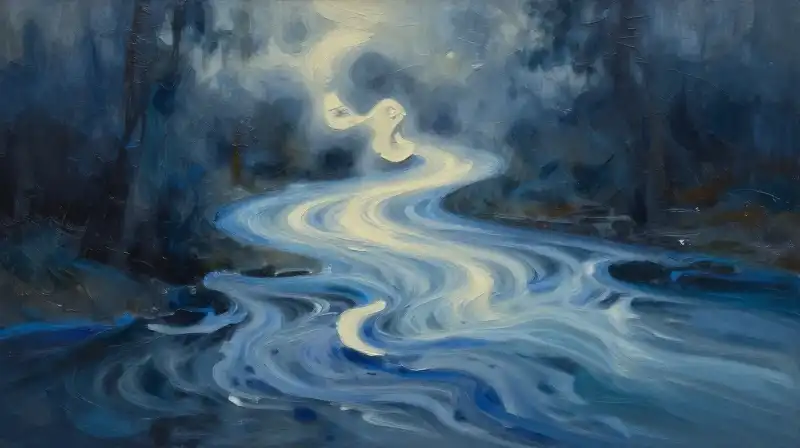
Coleridge describes a river that is “running” and “meandering with a mazy motion” [1]. On a literal level, we understand this as the movement of water. However, by applying human-like agency to the river, Coleridge elevates the scene from a simple description of geography to a moment of prophetic tension. The river’s movement toward the ocean serves a thematic purpose: the personified motion of the water creates a direct association between the river’s descent and a prophetic warning of war [1]. By giving the river “intent,” the poet transforms a natural cycle into a portent of human catastrophe.
How to Write a Personification Poem
Writing with personification requires a delicate balance. If overdone, the poem can slip into “purple prose” or feel clichéd; if underused, the imagery may feel flat. Whether you are a student looking for a way to approach a personification poem for students or a writer exploring a personification poem about life, the following steps can help guide the craft.
- Identify your “Actor”: Choose a non-human subject. This could be a tangible object (a rusted gate), a natural force (the wind), or an abstract concept (loneliness).
- Select a Human Trait: Avoid the obvious. Instead of saying “the sun smiled,” consider what specific human emotion or action fits the mood. Is the sun “staring judgmentally”? Is the wind “whispering secrets” or “screaming in rage”?
- Assign Intent: This is the most critical step for depth. Do not just describe how an object looks; describe what it is *trying* to do. If a house is “leaning,” is it leaning because it is tired, or because it is eavesdropping on the neighbors?
- Connect to Theme: Ensure the personification serves the poem’s larger purpose. If your poem is about the passage of time, perhaps the clock doesn’t just “tick,” but “paces impatiently” or “counts down with predatory precision.”
Literary vs. Common Personification

It is helpful to distinguish between personification used as a simple figure of speech and personification used as a deep thematic device.
| Feature | Simple Personification (Figure of Speech) | Thematic Personification (Literary Device) |
|---|---|---|
| Primary Goal | To add vividness or sensory detail. | To convey deeper meaning, allegory, or subtext. |
| Complexity | Usually a single adjective or verb (e.g., “the dancing flames”). | Involves agency, motive, and sustained characterization. |
| Effect on Reader | Creates a mental image. | Creates an emotional or philosophical resonance. |
Why Personification Matters
Personification remains a cornerstone of poetic expression because it addresses a fundamental human impulse: the desire to find connection in a vast, often indifferent universe. By imbuing the world around us with human qualities, we find a way to speak about our own experiences—our fears, our joys, and our mortality—through the medium of the world itself. Whether it is through the grand allegories of a morality play or the subtle, meandering river of a Romantic poem, personification allows us to see the “human” in everything, turning the external world into a mirror for the internal soul.
Sources

- Personification — poets.org
Related Articles